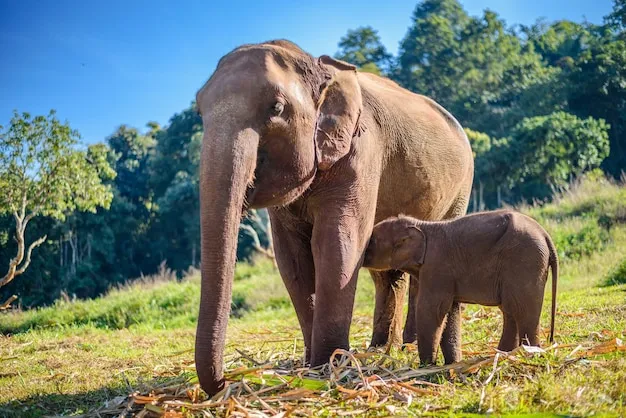
Have you ever heard someone say, “I have a memory like an elephant” when they remember something really well? It turns out this is one of those sayings that science has actually proven to be true! Based on decades of research I’ve studied from scientists around the world, the main reason why elephants have long memories comes down to one simple fact: their survival depends on it.
Unlike humans who can write things down or use GPS, elephants must remember where water is during terrible droughts, who their friends and enemies are, and how to find food across hundreds of miles. Their incredible memory isn’t just a cool party trick—it’s literally a matter of life and death for the herd .
I remember the first time I really understood this. I was reading a study from 2001 that completely changed how I think about these magnificent animals. Scientists followed elephant families in Kenya for seven years and discovered something amazing.
The herds with older grandmothers—the ones with the most memories—had way more babies survive than herds without grandmothers. Why? Because those old matriarchs remembered where to find food and water during bad times. Let me tell you, that really hit me. These wise old elephants carry maps in their minds that keep their whole families alive .
You may also read :- How to Train A Rescue Dog? A Step By Step Guide
The Matriarch’s Secret: Why Grandma’s Memory Matters Most
Speaking about the cause of elephants having long memories we simply cannot but speak about grandma. With the elephant families, the matriarch, or the oldest female, is actually the walking, breathing, trunk-swinging library of all things the family requires to know.
Dr. Karen McComb of Sussex University in England, an animal behavior researcher did some very ingenious experiments with wild elephants in Kenya. She used recordings of elephant calls to various families. The younger matriarchs were confused easily. But the older matriarchs? They immediately recognized whether the voice was familiar or not. Dr. In a BBC interview McComb said, "Elephants do have the capability of accumulating a memory over years and retaining it" .
And this is what will happen with elephants! The research established that families that had elderly matriarchs were in a position to take more time eating and playing since grandma was aware of who was secure and who was not. They did not squander their efforts in being afraid of everyone.
Learning From the Wise Ones: How Elephant Knowledge Gets Passed Down
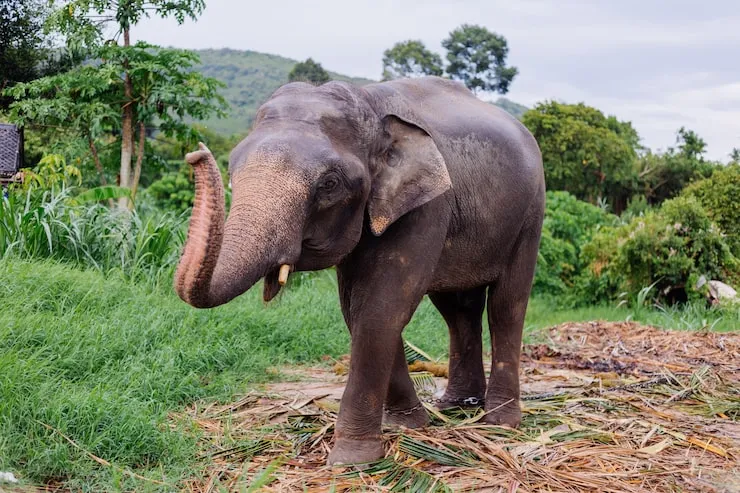
There is something quite beautiful about a mechanism of elephant memory, it is not just about memorizing facts. It is a matter of experience and educating the youth.
Scientist Joshua Plotnik, who has been studying animal thinking at Hunter College in New York, describes the kind of society that the elephants inhabit according to researcher terminology as fission-fusion societies. That is a posh term to say that the family at times separates to get food and then reunite. Think of what would happen to your classroom at lunchtime, when they are split up and then they have to find each other again in a large mall. A pretty good memory would be needed to get together, you know? That is just what elephants do .
The baby elephants follow the matriarch wherever they go. As she makes a left swing at one tree, they recall. They listen when she pauses to sniff the air. By her becoming nervous with some human beings who happen to wear red clothes, they become nervous as well. This is not merely an instinct and it is an example of cultural knowledge transmitted to generations.
The Elephant Brain: A Memory Machine Built for Survival
Alright, we will take a minute and peep into the head of an elephant. I promise this won’t hurt! In fact, scientists have been studying the brains of the elephants with the MRI machines, which are the same machines used by doctors to examine the brains of human beings.
Dr. Nina Patzke and her colleagues examined the brains of African elephants and came up with some very interesting findings. The brain section that aids in memory is referred to as the hippocampus (saying that three times quickly!). In us, our hippocampus assists us in recalling our whereabouts to our keys and what we did yesterday. The hippocampus is a little larger in elephants than it is in humans that is, it is approximately 10.84 cubic centimeters versus our 10.23.
But size isn’t everything! It is not what is on the outside that counts. The scientists discovered that the brains of the elephants possess all the same memory parts which other mammals possess and something special is occurring. They discovered signs of adult neurogenesis- using science talk that is, growing new brain cells. Their brains continue with new neurons even in adult elephants. This may assist them in retaining new memories during their extremely long lives that may be 60 or 70 years.
More Than Just a Big Brain: The Temporal Lobe Connection
Another section of the elephant brain is very fascinating. The area in the brain that is known as the temporal lobe, the one that facilitates the processing of memories, is far more folded in an elephant than a human being. Consider it as follows- in case you wish to put more paper in a notebook, you can use thinner paper or you can increase the number of pages. You add folds, wrinkles, however, you wish to have more brain in the skull. The more folds, the more surface area has, the more brain ability to remember things.
Professor Kim Ji-eun who has conducted a study of the brains at Ewha Womans University in South Korea, states that the secret ingredients to the elephant memory are repetition and feeling. Elephants are better at remembering what has happened repeatedly, or what has given them strong emotions. That is really like human beings! You are likely not to recall what you had to eat three weeks ago but you certainly recall your best birthday ever or the time you got so scared. It is the same with elephants, they have more space to hold on to those memories.
Using All Their Senses: How Elephants Recognize Friends and Foes
We learned one more thing that was very important in the Bibi and Panya study. Elephants recognize others through all the senses they have, however, their sense of smell may be the strongest. There are approximately 2,000 African elephant smelling genes. That is more than any other animal scientists have researched! By way of comparison, there are approximately 800 dogs to one, and approximately 400 humans. Their noses are so good no wonder.
The researchers observed that the elephants displayed the most response to smells, followed by sounds, and pictures. This will be reasonable considering the life of the elephants in the wild. When they are surrounded with thick bushes and trees they often cannot see each other but smells can travel a long way. Their great ears are able to detect low rumbling sounds which pass through the ground over miles. Then they are constructed on the senses most actively utilised.
Real Stories of Elephant Memory That Will Amaze You
I would like to tell some actual stories which demonstrate the operation of the elephant memory. These are not fanciful stories, but are recorded by those scientists and zookeepers who deal with the elephants on a daily basis.
There is a zookeeper, Ji In-hwan at the Seoul Grand Park zoo in South Korea, who attends to the wounds of the elephants. He is forced to apply sharp things to heal wounds or mend aching feet. The elephants have learnt to keep in mind that he is the one who hurts.
The elephants are a little jumpy with him even when he does not have any tools in his hand. However, what is the most interesting thing here, when one of the misbehaving elephants begins to act up, the keepers have found that by pretending it is a stern elder zookeeper, the elephant consequently listens more. They recall the voices that are serious business.
Yeo Yong-gu, a veterinarian who was employed at the same zoo, realized that there was something interesting about the way of how the elephants relate memory to things. He informed the reporters that when he comes to an animal with a hand in hand, it will not respond much but when he goes to the animal with a syringe to treat it, it will run away. The elephants do not merely possess memories of people but of what they carry and what it means of them.
When Memory Saves Lives: Elephants and Drought?
Surviving droughts may be the most significant survival reason of elephants to have long memories. Tanzania experienced a horrible drought in 1858 to 1961. That’s over 100 years ago now! Researchers who observed the herds of the elephants found that the herds that had older matriarchs lasted longer compared to those that did not have old females.
Why? The old elephants knew where to get water and food when there was a drought, because some of them recalled 35 years ago! They would take their families to concealed water holes which were unfamiliar to young elephants. It is described in a very simple way by Professor Jang Yi-kwon of Ewha Womans University: “Animals are able to keep in memory that they need to survive longer than others do.
How Elephant Memory Changes Everything About Their Lives?
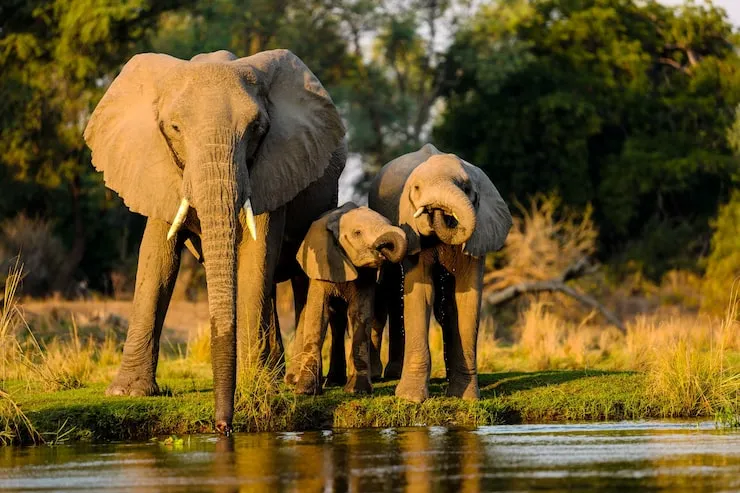
Once you learn the reason behind animals like the elephant having long memories, then you begin to look at their entire world differently. Every river, every elephant, every man they pass, is fixed on a mental map they will carry with them eternally.
In 2024, everything that has been known about elephant memory was reviewed by Dr. Sydney Hope and her team at Hunter College. They discovered that there are three things that elephants store in memory: directions to get about (spatial memory), friends and relatives (social memory), and significant events (episodic-like memory).
However, the next thing that they found astonishing is the fact that some scientific studies on the subject of elephant memory are not actually as numerous as you might imagine! All these stories and sayings we are aware of, and yet scientists are busy to figure out how exactly elephant memory functions.
What Elephant Memory Teaches Us About Our Own Lives?
The thing is that, I do not know whether you know or not, but reading about elephant memory, I start to think about my own memory. The reason is that the elephants can remember the location of water so that their families can survive. Their friends are recalled in more than ten years. They give knowledge to their children and grandchildren.
Perhaps, we can learn something with these kind giants. Memory does not only involve the ability to recall stuff to pass a test. It has got to do with belonging to us, our families, our friends, places that we hold dear to our hearts. She is not remembering a place when an elephant grandmother takes her family to the water in a drought. She means, I love you all and I will do all I know to protect you.
Conclusion: The Amazing Gift of Elephant Memory
Now you understand the true account of the reason why elephants have long memories It’s not magic. It’s not just a lucky accident. It is a super power that has taken millions of years in the evolution of the elephants just to enable them survive in the world which is not so easy.
Well, I will never look at an elephant in the same way that I did, I think. Whenever I look at the image of a wise old elephant in her family, I will remember all the notions in that huge head of hers. All the droughts that she endured. All the babies she raised. All the miles she walked. Her friends and friends she lost. And I will be thankful that we have been blessed to this world with creatures that show us that so much more is involved in memory than remembering it, but love and survival and the imparting of wisdom across generations.
Frequently Asked Questions About Elephant Memory
Q: Are the elephants really incapable of forgetting anything?
A: That is a good expression, but it is not quite true. No animal, not even human beings, can remember everything. But still, elephants are incredible in their memories of things that are important to their survival such as, where to get water, mates and enemies, and how to make it in their complex social environment.
Q: The duration of the memory of the elephants?
A: It has been overwhelmingly demonstrated that elephants can recall certain individuals not less than 13 years . One thing that was found by observing the wild elephants as they find water during droughts is that they are likely to remember key locations within a maximum of 30-40 years or more.
Q: Which is the greatest remembered, an elephant or a human being?
A: That is to ask whether a fish is not a better swimmer than a bird is a flyer! We are different at doing things. Human beings are very good in recalling facts and narrating past stories. Elephants are wonderful in recalling sites and social association over a considerably extensive length of time. We make great memories both of us--only to different ends.
Q: Do elephants remember people who were mean to them?
A: Yes, absolutely. Zookeepers have noticed that elephants remember which people caused them pain, even when those people aren’t holding anything scary. They also remember which people were kind to them. One study even suggests that testing elephants with people they don’t like might teach us even more about their memory .
Q: Why do elephants need such good memories?
A: Because their lives depend on it! They live in complicated family groups, travel long distances to find food and water, and need to know who’s safe and who’s dangerous. Without good memory, elephant families wouldn’t survive droughts or know how to avoid enemies .