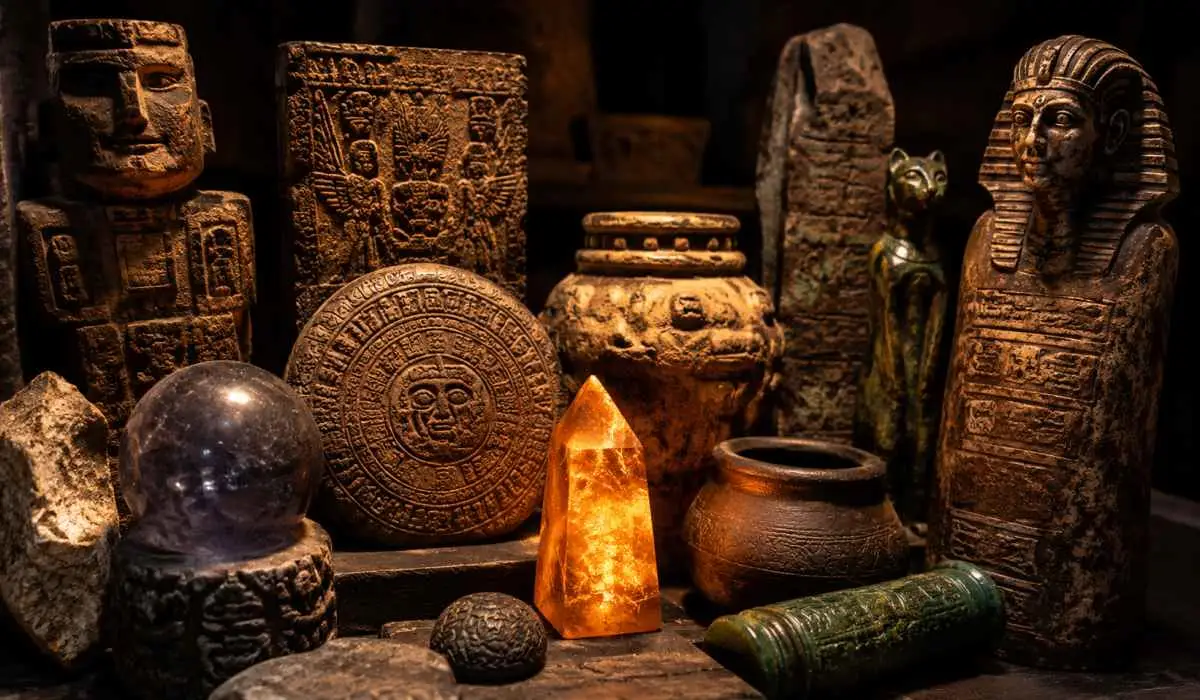
Ancient civilisations left behind more than temples, coins, and statues. They also created strange objects whose real purpose remains a mystery. These mysterious ancient artefacts continue to interest archaeologists, historians, and curious readers around the world. Some look like tools, while others seem far ahead of their time.
The Roman dodecahedron, Voynich Manuscript, Lycurgus Cup, and Antikythera mechanism are among the most famous examples. Researchers have suggested many possible answers, but several questions remain open. From unusual Roman objects to mysterious Egyptian and Greek discoveries, these artefacts show how much we still do not know about the ancient world today.
Mysterious Ancient Artefacts That Still Puzzle Experts
From strange Roman objects to unusual Egyptian discoveries, these ancient artefacts have created many questions. Some have possible explanations, while others remain difficult to understand even after years of research.
Roman dodecahedron
A child’s toy? Or a weapon, or a knickknack for a Roman home bookshelf? The meaning of these hollow little metal balls of copper, with 12 flattened pentagonal sides, has puzzled archeologists since someone dug up the first in England in 1739.
Since then, people have found the 116 known dodecahedra all over the Roman Empire - in Belgium to Hungary, often in coin hoards. One guess is they were knucklebones or a tool for finger knitting with.
Read More: Dumb Genius Business Ideas That Became Million-Dollar Successes
Nimrud Lens
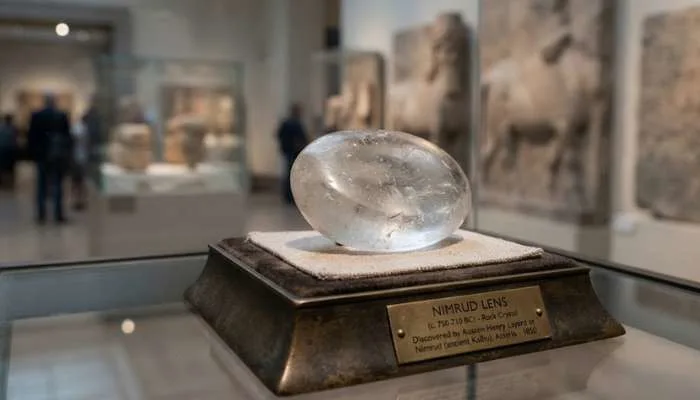
Austen Henry Layard uncovered an eighth century B.C. carving from the Assyrian palace at Nimrud in Iraq in 1850 and thought it served as a magnifying glass or the burning lens used to focus sunlight to make fire, though others considered it just a bit of inlay.
Giovanni Pettinato, an Italian scientist from the University of Rome, proposed the theory that it might have been a lens from the telescope used by the Assyrians to chart the cosmos; and from then on, people referred to it as the Nimrud Lens, though its quality of optics doesn’t inspire enough credibility to be taken seriously by other researchers of the subject.
Lycurgus Cup
On the face of it, this 4th-century Roman glass cup depicting the death of King Lycurgus looks rather ordinary - for the period, at least. But when various angles illuminate the cup it’s like a little light show: from the front it flashes green, and from behind it glows red.
Scientists stumbled upon the secret behind this chromatic sorcery: gold and silver particles suspended in glass a unique technique they plan to exploit for optics, microscopy, nano-science and the arts.
Voynich Manuscript
The Voynich Manuscript is an illustrated codex written by hand in an unknown language. Its style is typical of the Italian Renaissance, but the script – which scientists call ‘Voynichese’ has defeated many of history’s top cryptographers, including iconic mathematician, Alan Turing. The book’s carbon dating has placed it squarely at the start of the 15th century but its function has remained a riddle.
Earlier this year (2017) historian Nicholas Gibbs suggested he was getting near to cracking the code. After observing the wealth of drawings of women soaking in bathtubs, he theorises the Voynich is, in fact, a women’s health guide. Whatever the truth, ultimately the Voynich has no more made sense today than it did 100 years ago, in 1912 when someone found it in Italy.
Holey Jar
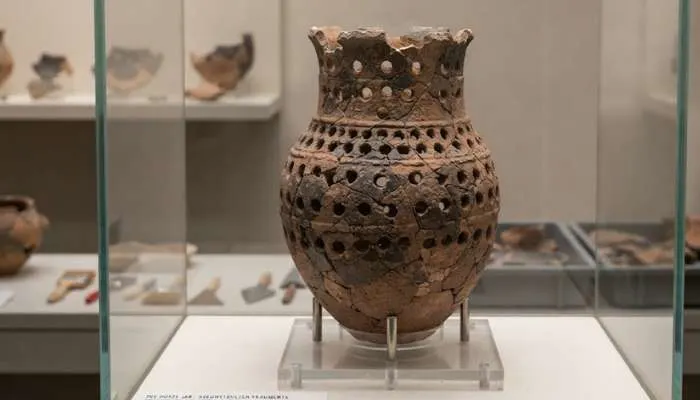
The so-called 'Holey Jar' has done nothing but deepen their mysteries since archaeologists reconstructed it in 1980 from a jumbled mess of 123 fragments that they salvaged from a storage closet at the Museum of Ontario Archaeology.
The original provenance is confusing enough the closet where they discovered this artifact held an eclectic mix of objects that Welsh archaeologist William Francis Grimes collected from digs at the Mithraeum, or the Roman temple of Mithras in London, alongside archaeological finds that Leonard Woolley retrieved at the ancient Sumerian city of Ur in Mesopotamia.
Even more frustrating is the meaning of the jar's eponymous holes - no other artifact exists exactly like it, and archaeologists can only speculate as to the Jar's ultimate use.
Folkton drums
Archaeologists laid these sumptuously decorated chalk drums to rest beside a child in Folkton in East Yorkshire about 5,000 years ago, and even today, historians continue to be baffled by them ever since their excavation in 1889. Theories about their purpose ranged from interpretations as depictions of storing vessels to geometric designs that related to astronomical knowledge.
However, a study conducted by University of London and Manchester University has revealed that these drums might actually serve a practical use that has eluded experts functioning as Neolithic tapemeasures, where cord is wrapped around the drums to provide accurate lengths. Yet, this information alone does not explain why archaeologists have found these drums alongside a child who could only have been two years old at the time of interment.
Saqqara Bird
Did the ancient Egyptians fly? The discovery of a small wooden bird in a tomb at Saqqara sparked suggestions that they may have mastered the principles of aviation many years before we believe those principles were invented. Carved in 200BC, it measures 5.5 inches (14cm) long with a seven-inch (18cm) wingspan, and, without a doubt, it closely resembles a toy glider.
Nevertheless, when glider design manufacturer Martin Gregorie created an exact replica, he found that it proved far too unstable to fly. Experts today mostly believe that the bird served as a religious effigy, toys, or perhaps a wind vane that perched on religious boats.
You May Also Read: Dumb Genius Moments in TV Shows and Movies You Totally Missed
Antikythera mechanism
When they recovered this astonishing piece of clockwork from an ancient Greek wreck off a small island called Antikythera in 1900, it appeared to be nothing but a boring hunk of green bronze. A few months later, it cracked, revealing its tiny gears and beginning 100 years of speculation.
Some people described it as a clock for observing the stars while others used it as a tool. In 1905, philologist Albert Rehm said it was "an astronomical calculator that can predict future eclipses long before they are about to happen." In the future, we have learned one thing for certain; its complexity was unlike any of its time.
FAQs
1. What are mysterious ancient artefacts?
Mysterious ancient artefacts are old objects whose original purpose, meaning, or method of creation is still uncertain. Researchers may have theories, but there is no confirmed answer.
2. What is the most mysterious ancient artefact?
There is no single answer. The Voynich Manuscript, Roman dodecahedron, and Antikythera mechanism are among the most famous mysterious ancient artefacts because they continue to raise questions.
3. What was the Roman dodecahedron used for?
Its exact purpose is unknown. Suggested ideas include a measuring tool, craft object, religious item, or other everyday use.
4. Is the Antikythera mechanism real?
Yes. It is a genuine ancient Greek mechanical device recovered from a shipwreck. Research shows that it was used for complex astronomical calculations.
5. Why is the Voynich Manuscript mysterious?
The manuscript is mysterious because its writing system has not been reliably deciphered. Its illustrations also make its original purpose difficult to determine.